
Airless Dispensing
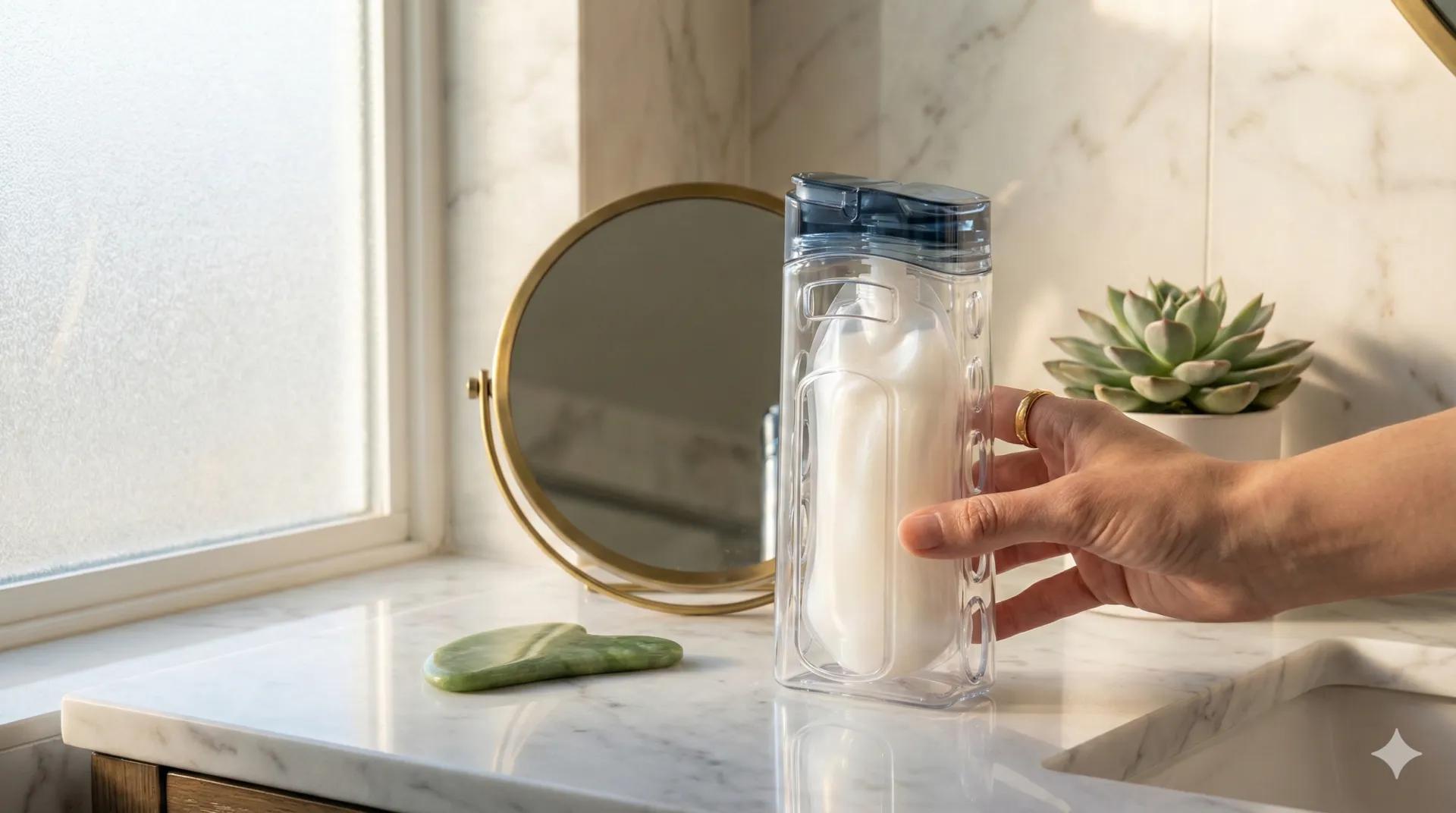
Today's airless packaging relies on pumps, pistons, or pressurized propellants. Anti Gravity Bottle delivers true airless dispensing with zero moving parts.
The Problem
Complex, Expensive Airless Systems
Current airless packaging (pumps, pistons, bag-on-valve) adds $2-5+ per unit in cost. Complex mechanisms increase failure rates and manufacturing complexity. Only premium products can justify the expense.
Airless pumps add $2-5+ per unit in packaging cost
Propellant-Dependent Dispensing
Aptar's Bag-on-Valve (BOV) technology dominates at $2.5-3B but requires pressurized propellant, is single-use, and adds manufacturing complexity. The propellant itself raises environmental and regulatory concerns.
Limited to Premium Price Points
The cost of airless dispensing restricts it to premium cosmetics, pharmaceuticals, and specialty products. Mass-market products that would benefit from airless protection cannot justify the packaging cost.
The Anti Gravity Bottle Advantage
Zero Moving Parts
The collapsing inner bag naturally excludes air. The dual-state cap controls dispensing. No pumps, no pistons, no valves, no propellant. Simpler means cheaper, more reliable, and easier to manufacture.
Fraction of Current Airless Cost
Anti Gravity Bottle's mechanical simplicity means airless dispensing at commodity packaging cost. This opens airless protection to mass-market products for the first time.
Replaceable Pouches
Unlike current airless systems which are fully disposable, Anti Gravity Bottle's outer bottle is reusable. Only the inner bag needs replacement, cutting per-use packaging cost and waste dramatically.
Market Opportunity
Market Size
$6-10B
Growth
5.8% CAGR in airless packaging
Aptar Group's Bag-on-Valve (BOV) division generates $2.5-3B alone, proving massive demand for airless dispensing. Anti Gravity Bottle offers the same air exclusion with no propellant, no moving parts, and replaceable pouches at lower cost. The addressable market expands when airless becomes affordable for mass-market products.
Current Approaches vs. Anti Gravity Bottle
Current Approach
Bag-on-Valve (Aptar BOV), airless pumps (vacuum-driven piston systems), and sealed ampoules. BOV is the dominant technology at $2.5-3B market share.
Limitations
BOV requires propellant and is single-use. Airless pumps are expensive ($2-5+/unit) and have complex mechanisms. Ampoules are single-dose only. All current airless systems are fully disposable.
The Anti Gravity Bottle Difference
Anti Gravity Bottle delivers airless dispensing with no propellant, no moving parts, at commodity packaging cost. The reusable outer bottle with replaceable pouches creates a fundamentally different cost structure and sustainability profile.
Why Now
Propellant regulations are tightening globally. Sustainability pressure is making single-use airless systems harder to justify. The cost barrier that limits airless to premium products is increasingly seen as a market opportunity. Anti Gravity Bottle makes airless affordable for the mass market.
Related Industries

Ready to Explore Licensing?
Get the full technical white paper with market data, implementation roadmap, and licensing models.
Request White Paper